Why Peptide Design is the Next Frontier in AI Drug Discovery
News Details
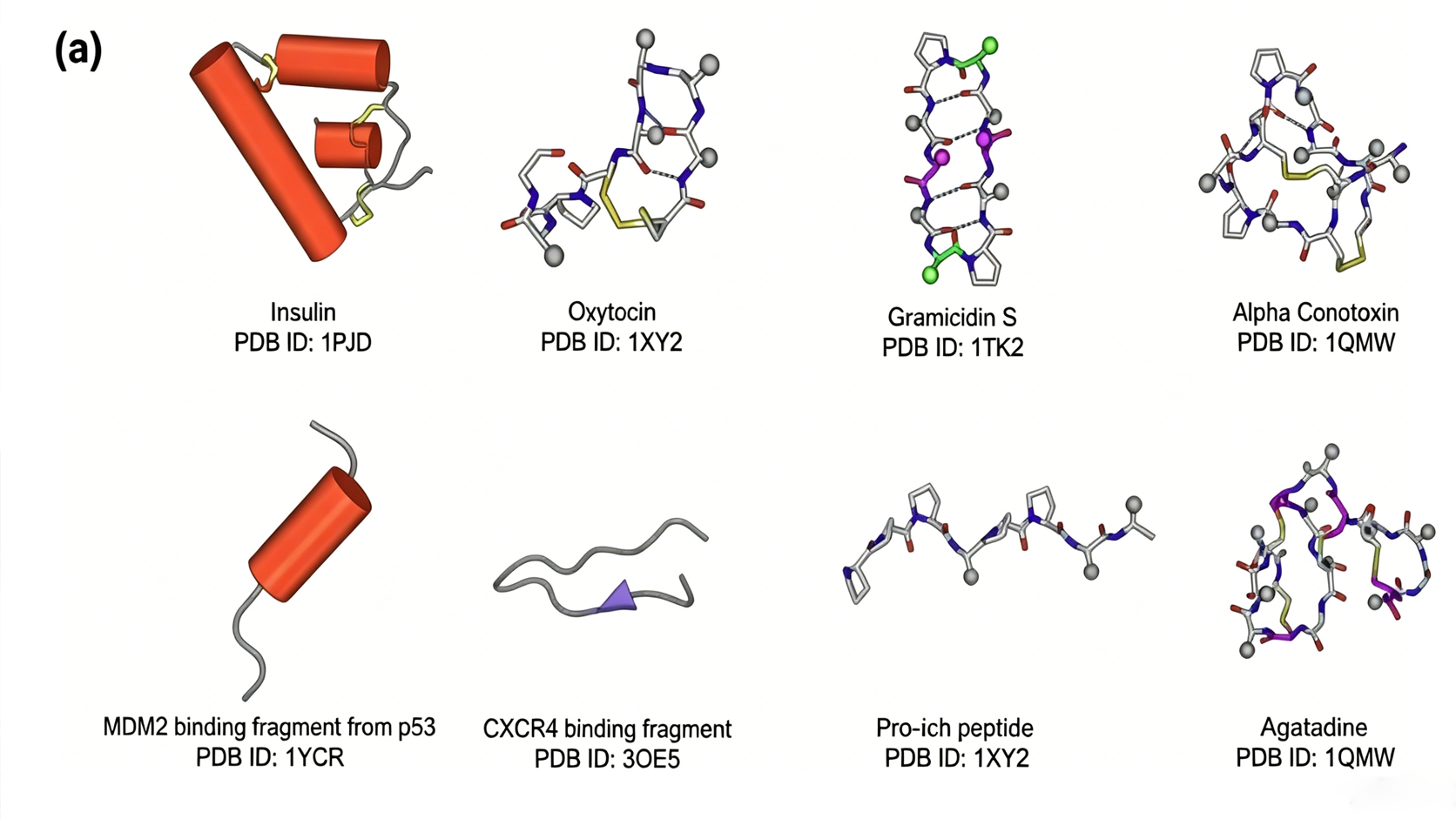
In the landscape of modern pharmacology, Peptide Drug Discovery has emerged as a high-stakes arena. Often described as the "middle ground" between small molecules and biologics, peptides are uniquely positioned to tackle targets that were previously considered "undruggable."
With the recent explosion of generative AI and structural biology models, AI-driven peptide design is moving from laboratory curiosity to a cornerstone of pharmaceutical R&D. Here is an in-depth analysis of why peptides are the next AI "breakout" hit.
01 | The "Goldilocks" Molecule: Why Peptides?
The fundamental logic for peptide drug discovery lies in their unique physical and chemical properties.
- Bridging the Gap: Small molecule drugs are often unable to bind to large, shallow Protein-Protein Interaction (PPI) interfaces because they lack deep "pockets" to anchor into.
- Targeting Intracellular Space: While antibodies (biologics) are excellent at identifying surface proteins, their large size prevents them from crossing cell membranes to reach intracellular targets.
- The Peptide Advantage: Peptides possess enough flexibility to adapt to protein surfaces while maintaining high specificity and affinity. This makes them the ideal "key" for unlocking intracellular PPI targets.
- Proven Track Record: Peptide therapy is not new—from insulin to over 100 FDA-approved peptide drugs—but AI is now accelerating this field into a high-speed development phase.
02 | The Data Barrier: Quality over Quantity
In the world of AI, the first hurdle isn't the model—it’s the Data Foundation. Peptide design differs significantly from general protein design due to the scarcity of high-quality structural data.
- Structural Scarcity: Databases like ProPedia, PepBDB, and CPSet provide the bedrock for training, but they are often plagued by redundant samples, short peptides, or outdated web hosting.
- Innovative Data Sourcing: Leading researchers are now treating protein loop regions as "pseudo-peptide" resources. Because loops mimic peptide behavior in structural and dynamic ways, they serve as a vital reference to fill the conformational space of peptides.
- The Hybrid Future: The future of peptide design depends on integrating "Real Experimental Structures + Virtual Predicted Structures (from AlphaFold DB) + Sequence Knowledge."
03 | From Prediction to Design: The Three Levels of AI Competency
The evolution of AI in this sector follows a clear trajectory of increasing complexity.
Level 1: Interaction Prediction
Answering where a protein surface might bind a peptide and identifying critical residues. Models like PepNN, CAMP, and MaSIF integrate protein structure, sequence, and surface geometry to predict "if and where" binding occurs.
Level 2: Complex Structure Prediction
Moving beyond "if" to "how." While traditional docking struggled with high-flexibility peptides, a new generation of models—AlphaFold 3, RoseTTAFold All-Atom, Chai-1, and Boltz-1—has revolutionized multi-component modeling. However, systematic benchmarking for non-natural and macrocyclic peptides remains a challenge.
Level 3: Target-Specific Design
This is the current "Hot Zone." AI is no longer just analyzing; it is generating new molecules from scratch to bind specific targets.
04 | The Three Generative Routes for De Novo Peptide Design
The review highlights three primary AI pathways currently competing for dominance in the de novo design of binders.
4.1 Hallucination-Based Design: Iterative Optimization
This "inverse creation" logic uses a structure prediction model to judge if a random sequence will fold into the desired target shape.
- EvoBind & EvoBind2: These models don't require pre-known binding sites. EvoBind2 reported a hit rate of 75% for macrocyclic peptides and 46% for linear peptides, with affinities ranging from micromolar to sub-nanomolar levels.
4.2 Sequence-Structure Co-Design: The Diffusion Revolution
These methods allow the structure and sequence to evolve together during generation.
- DiffPepBuilder: Based on SE(3)-equivariant diffusion, it integrates protein language model embeddings and torsion angles.
- PepFlow: Uses flow-matching techniques to provide high-quality diversity in geometric and energy metrics.
4.3 Sequence-Based Methods: Designing for "Disordered" Targets
Many high-value targets (like transcription factors) lack stable structures or are highly disordered. For these, Protein Language Models (pLMs) are the superior choice.
- PepMLM: This model uses "mask filling" at the end of a protein sequence to generate a binder, reporting hit rates over 38%.
- Cut & CLIP: This moves from "Binding" to "Degradation," using contrastive learning to design peptides that trigger E3 ligase-mediated degradation.
Conclusion: Why Now?
The transition of AI from "predictive assistant" to "generative chemist" marks a turning point. By combining structural geometry with sequence-based linguistic logic, AI is finally solving the conformational complexity of peptides. For drug discovery, this means a faster, more accurate path to targeting the "undruggable" interior of the cell.


