A Step-by-Step Guide to Evaluating Anti-Wrinkle Serum Test Reports for Clinical Skincare Claims
News Details
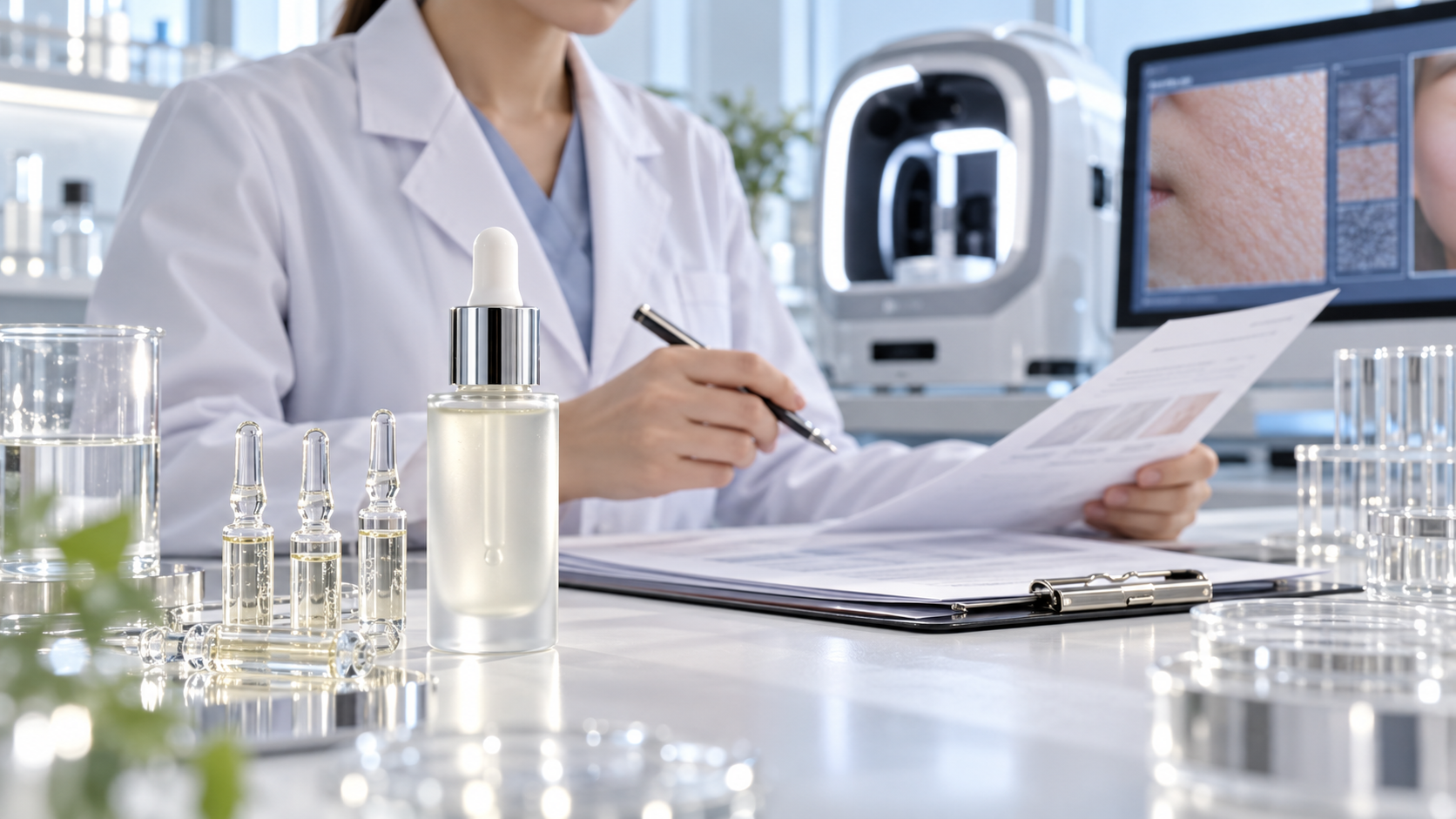
An anti-wrinkle serum report may show impressive numbers, clear charts, and strong before-and-after images. However, those features alone do not tell a brand whether the evidence supports its planned claims.
For skincare brands, distributors, and private-label buyers, the key question is simple: Does this report support what we want to say about the product we will sell?
Good anti wrinkle serum efficacy testing connects a defined formula with a clear benefit, a suitable method, and reliable results. It also explains the limits of those results.
When reviewing JIMEIJIAER peptide products or planning a new serum range, use the following steps to assess reports, compare evidence, and build more precise product claims.
Start Anti Wrinkle Serum Efficacy Testing Reviews with Product Identity
First, confirm what the laboratory actually tested. A report on a peptide raw material is different from a study on a finished serum.
Likewise, a report on an earlier formula may not fully support a revised product. Changes in active levels, preservatives, the base, or delivery format may affect performance.
Ask for these details:
- Full product name and sample code.
- Formula version and batch number.
- Sample receipt and testing dates.
- Application amount and frequency.
- Packaging or preparation method.
- Report number, laboratory name, and authorized signature.
Then match the tested sample to the product specification in your purchase agreement.
For a freeze-dried product, check the mixing instructions, liquid volume, and time between preparation and use. These details help establish whether the test reflects the customer’s actual routine.
Match Clinical Skincare Claims to the Evidence
Next, identify the exact benefit measured. “Skin feels smoother,” “wrinkle depth decreased,” and “skin hydration increased” describe different outcomes.
A consumer survey can support a carefully worded statement about user perception. It does not, by itself, establish a measured reduction in wrinkle depth. Similarly, increased hydration does not automatically prove improved firmness.
For EU sales, cosmetic claims must have adequate, verifiable support. Studies should relate to the product and benefit claimed, and ingredient properties should not be presented as finished-product benefits without suitable evidence.
Use this distinction when reviewing clinical skincare claims:
| Evidence provided | What it may support |
| Consumer questionnaire | What users reported seeing or feeling |
| Trained expert grading | Changes assessed using a defined visual scale |
| Wrinkle surface measurements | Changes in specified wrinkle dimensions |
| Skin hydration measurements | Changes in the measured hydration parameter |
| Laboratory ingredient study | The ingredient’s activity under those test conditions |
The wording should follow the evidence, including its limitations.
Review Participants in Anti Wrinkle Serum Efficacy Testing
A study is more useful when its participants match the intended customers.
Check their age range, starting wrinkle severity, skin characteristics, and the facial area assessed. A study focused on crow’s feet does not automatically support the same result for forehead lines.
Also compare how many people enrolled with how many completed the study. Ask why participants withdrew and how missing results were handled.
There is no single participant count that makes every study strong. The number needed depends on the study design, expected effect, and variation between participants. Cosmetics Europe’s efficacy guidance highlights the importance of statistical planning and choosing methods suited to the intended benefit.
Finally, check whether participants changed other skincare products during the trial. New treatments or major routine changes can make the serum’s contribution harder to judge.
Check Controls in Anti Wrinkle Serum Efficacy Testing
A before-and-after improvement is useful, but it does not always explain why the change occurred.
For example, the base formula may improve the look of dry lines. Weather, daily routines, or measurement variation may also influence the result.
Ask what comparison the study used:
- Untreated area: compares product use with no application.
- Vehicle control: compares the formula with a suitable base lacking the ingredient being assessed.
- Benchmark product: compares performance with another defined product.
- Split-face design: applies different treatments to opposite sides of the same person’s face.
Each approach answers a different question. A vehicle comparison can help assess an ingredient’s added contribution, while an untreated comparison can help assess the finished product.
Also check random assignment and blinding. When practical, keeping assessors unaware of treatment allocation can reduce bias in grading.
Understand Wrinkle Measurement Skincare Methods
For wrinkle measurement skincare reports, a device name alone is not enough. Buyers need to know what the instrument measured and how the laboratory used it.
Common approaches include three-dimensional skin imaging, analysis of skin replicas, and standardized photographs. Expert grading can add another view of the visible change.Ask whether the reported measure describes wrinkle depth, volume, area, count, or surface roughness. These measures are related, but they are not interchangeable.
Japanese Cosmetic Science Society guidance also distinguishes visual, photographic, and instrumental assessments when evaluating anti-wrinkle products. Its framework shows why the measurement approach must match the intended claim and product category.
A useful report should identify:
- The device and analysis software.
Check Conditions Behind Wrinkle Measurement Skincare Results
Even a suitable method needs consistent conditions.
Review whether the laboratory controlled room temperature, humidity, and the time participants spent resting before measurement. Also check instructions on cleansing, makeup, and recent product application.
For photographs, lighting, camera position, facial expression, and head angle should remain consistent. Smiling in one image and relaxing the face in another can change how lines appear.
Timing matters as well. A measurement taken shortly after application may capture a temporary smoothing effect. A measurement after several weeks answers a different question.
Therefore, ask when the last dose was applied and whether the study assessed immediate effects, repeated-use effects, or both.
The report should make those differences clear rather than presenting every improvement as a lasting result.
Read Percentages Carefully in Clinical Skincare Claims
A percentage has little value without a clear definition.
For example, “90% of users reported smoother skin” does not mean wrinkles became 90% shallower. Likewise, an average improvement differs from the best result achieved by one participant.
Consider a hypothetical wrinkle-depth measurement that falls from 100 to 85 units. That represents a 15% reduction from baseline. It does not mean 15% of wrinkles disappeared.
Also check whether a reported percentage was calculated from group averages or by averaging each participant’s percentage change. Those approaches can produce different numbers.
Ask for baseline values, final values, variation, and confidence intervals where appropriate. Statistical significance helps assess the evidence, but it does not tell you whether a change is large enough to be clearly visible.
If many outcomes were tested, ask how the analysis addressed the risk of chance findings. Avoid selecting only the most favorable result.
Assess JIMEIJIAER Products for Anti Wrinkle Serum Efficacy Testing
JIMEIJIAER’s peptide skincare range
includes the Peptide Anti-Wrinkle Radiance Single-Dose Ampoule Serum. Its listed peptide ingredients include Arginine/Lysine Polypeptides, Acetyl Hexapeptide-8, Nonapeptide-1, and Decapeptide-4. The website also presentsPolypeptide Anti-Wrinkle Perfecting Essence
, Multi-Peptide Anti-Wrinkle Essence, and Multi-Peptide Anti-Wrinkle Firming Eye Cream. Its product positioning includes multi-peptide formulas and freeze-drying technology.These products provide practical starting points for a sourcing discussion. However, each selected product needs evidence linked to its own formula and intended claims.For an ampoule serum, request the application schedule and preparation details used in testing. For an eye cream, check that the report assessed the relevant eye-area concern.
If a product is presented around a 28-day cycle, request the underlying report before adopting that timeline. Confirm the outcome, participant group, and conditions behind the statement.
Separate Tolerability from Clinical Skincare Claims
A wrinkle efficacy study and a safety assessment serve different purposes.
Review any recorded redness, stinging, dryness, or withdrawals related to discomfort. Also check how those events were collected and assessed.
However, a small study reporting no reactions cannot prove that a product will never irritate anyone. Similarly, “dermatologically tested” does not explain the test design or establish wrinkle reduction.
Request the relevant tolerability documentation separately. Then keep safety wording, efficacy wording, and consumer feedback distinct.
This gives sales teams clearer answers and prevents one report from being used to support unrelated promises.
Turn Anti Wrinkle Serum Efficacy Testing into a Buying Decision
Before approving a claim or placing a commercial order, request the complete report rather than relying only on a summary slide.
Use a simple decision checklist:
- Does the sample match the product being purchased?
When discussing a project with
JIMEIJIAER
, share your target market, selected product, proposed claims, and launch schedule. This helps both teams identify the evidence needed for a clear, credible product launch.


